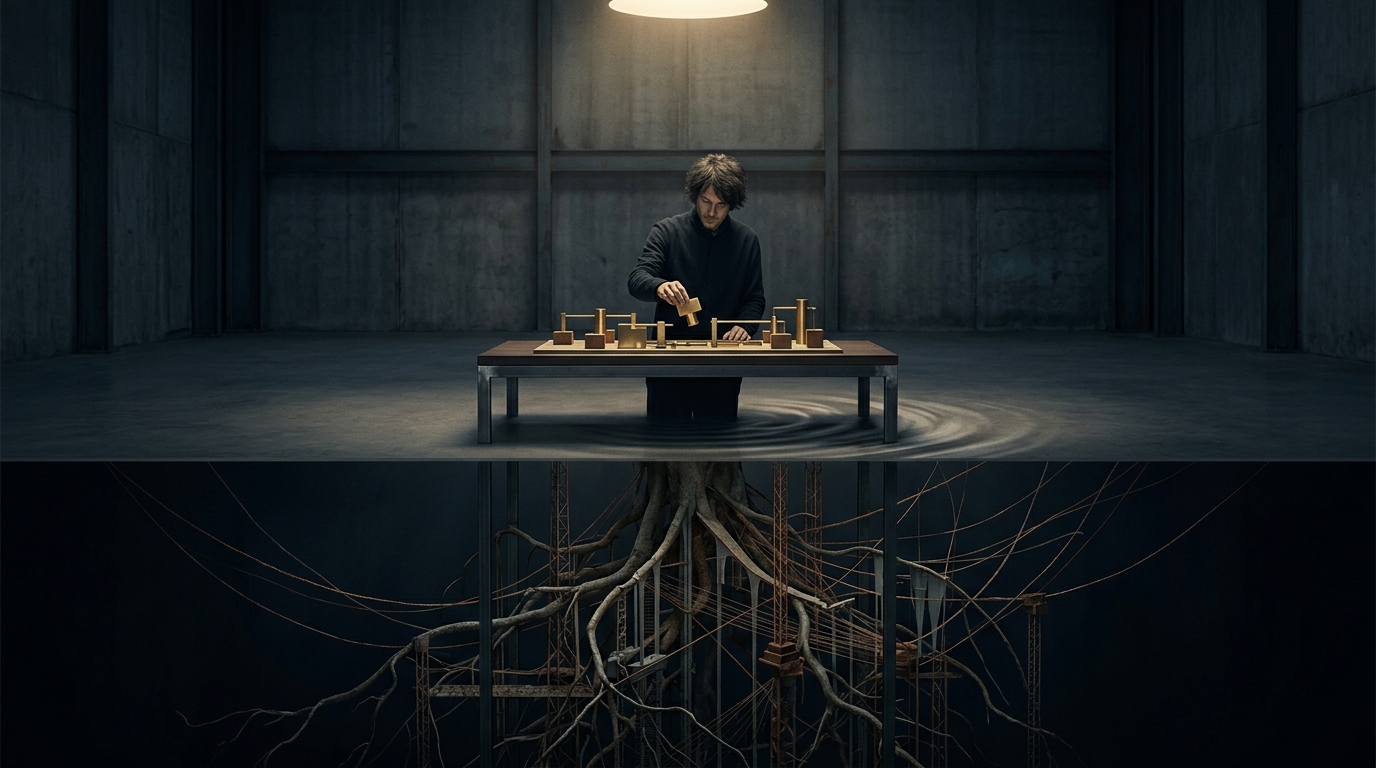
The Boundary of the Model
We usually recognize intelligence by what it makes possible: someone reads a situation, finds an opening, and gets the result they want. The success is visible. The limits of the understanding behind it are not.
A person can become very good at getting results within a small part of reality while understanding little of what surrounds it. They know what to move, where to apply pressure, which obstacle can be bypassed. Each success makes that knowledge feel more complete than it is.
Eventually, two assumptions start to pass for observations:
If I can manipulate it, I understand it. If I cannot detect a consequence, no consequence exists.
Neither holds. Getting the result we expected proves that our understanding worked for that result, under those conditions. It says nothing about what else happened.
Power Asymmetry Is Not Comprehension
An older child can be strong enough to overpower an infant while understanding almost nothing about the infant’s experience. The child can make something happen without knowing what it means to the other person, or how long its effects will last.
The child’s understanding explains the action. It does not set the limits of its consequences. Those unfold in the infant’s life, not in the older child’s account of what happened.
Technology extends our reach enormously, but it does not close this gap. We can alter an organism, reproduce some of its processes, or end its life. Each ability proves particular knowledge. None proves that we understand what the organism is.
Nor does evolution hand us a ranking that settles the matter. Some birds navigate by Earth’s magnetic field. Spiders engineer silk. Some bacteria thrive in conditions that would kill us. These are not unfinished attempts at being human. They are different ways of living, with histories and capacities of their own.
Our ability to overpower them is real. The mistake is treating it as the answer to a different question: how much of their reality do we actually understand?
The Visible Interface
The part we can reach tends to stand in for the whole.
Someone slips past the guard at a building’s entrance and concludes that its security has been beaten. In the moment, the conclusion feels earned: the obstacle is behind them, and they are inside.
But the building may also have cameras, access logs, alarms, and people whose job is to review them. Getting past the guard was a success at one level. Whether it was a success at all is something the intruder cannot yet know.
We make the same move with living things. We identify a stimulus, trace a nerve signal, and explain a response. The explanation can be accurate and enormously useful. The error comes when we can explain this response quietly becomes there is nothing else to explain.
Every measurement has a scope. An instrument tells us precisely what it was built to detect and nothing about what it was not. That is not a flaw in measurement. It is a limit on what we are entitled to conclude from it.
Consciousness is where that limit matters most. We can map the bodily processes that accompany experience in remarkable detail and still have no account of experience itself.
This is not a special failing of science. It is true of every limited capacity. However deep and powerful a capacity is compared with what surrounds it, it has bounds, and it is blind to whatever lies outside them. Its strength tells us how well it works within its range. It tells us nothing about where that range ends or what lies past it.
From inside, we cannot know what is beyond our reach. We can only know that our reach ends somewhere. Access to one part is not evidence of having understood the whole.
The Wager Inside the Choice
That gap becomes practical the moment an action cannot be undone.
Take an encounter with an animal in which the benefit is simple amusement and lasting injury is a foreseeable outcome. The enjoyment is easy to picture. What happens to the animal is harder to see, especially when its experience differs so much from ours.
Harder to see is not invisible. Animals recoil from injury, learn to avoid what hurt them, and try to escape. The evidence is stronger for some species than others, but it is evidence, and it points in one direction. Uncertainty is not a blank space in which every possibility is equally likely. Treating it that way simply counts the unanswered questions as zero.
If experience has a continuity our present models do not capture, the stakes are higher still. But the argument does not need that possibility. The difference between a passing benefit and a lasting injury is already enough.
Not every irreversible choice is a mistake. Much of life cannot be undone, and doing nothing has consequences too. But when the benefit is slight and the loss is lasting, nothing else was visible to me is not a justification. It is a description of where the looking stopped.
What looks like a simple preference contains a substantial wager about how complete our picture is.
The Time Beyond the Decision
Part of that wager concerns time. A choice can make sense within the period we are considering and look entirely different just beyond it.
If someone knew they had one hour left to live, spending everything on that hour might be reasonable. If they actually had twenty years ahead, the same choice would leave them with a long aftermath they never included in the decision.
Their reasoning was consistent. Their assumption about how much future remained was wrong.
The same thing happens when an action meets no immediate resistance. We get the result we wanted, nothing visibly goes wrong, and the encounter feels finished. But finished for our purposes is not the same as finished.
A debt remains whether or not anyone is asking for repayment. Pollution moves slowly through groundwater before reaching a place where anyone measures it. A signed contract seems to settle an agreement until questions about coercion or capacity become the center of a dispute.
None of these is exotic. Each has an ordinary mechanism and a delay. A quiet interval settles nothing on its own. Seeing nothing means something only if we were looking in the right place, for long enough, and knew what we were looking for.
What Cannot Be Put Back
Time also changes what repair can mean. A replacement can serve the same purpose as what was lost. Restitution can settle a claim. Neither erases the history in between.
With a living being, the distinction is stark. Another organism is not the return of the one that died. Recovery from an injury is not a life in which the injury never happened. Something can be repaired without being restored.
This is where the limits of understanding stop being merely intellectual. A mistaken explanation can be revised. The action taken on its strength often cannot. We can discover what we overlooked without being able to recover what it cost.
Gravity does not consult a person’s beliefs about a ledge. Consequences work the same way: where they exist, they do not wait for our models to include them, and failing to anticipate them is no protection.
What Our Confidence Depends On
None of this requires a universe that rewards kindness or punishes cruelty. It concerns the distance between being able to do something and knowing what doing it entails.
Three distinctions run through it: control is not complete understanding; an immediate result is not the whole aftermath; and compensation is not reversal.
Together, they show how much can be left out of a decision that feels completely rational. A person may know exactly how to get the result they want while knowing very little about what their success sets in motion.
Someone can still decide the choice is worth making. But that is a judgment about what they want and what they are willing to risk, not a discovery that the uncertainty has gone away.
The choice remains theirs. Where their understanding ends is not where the event ends.